Backstory of Dharmendra Pradhan resignation: Modi's falling piece after a decade
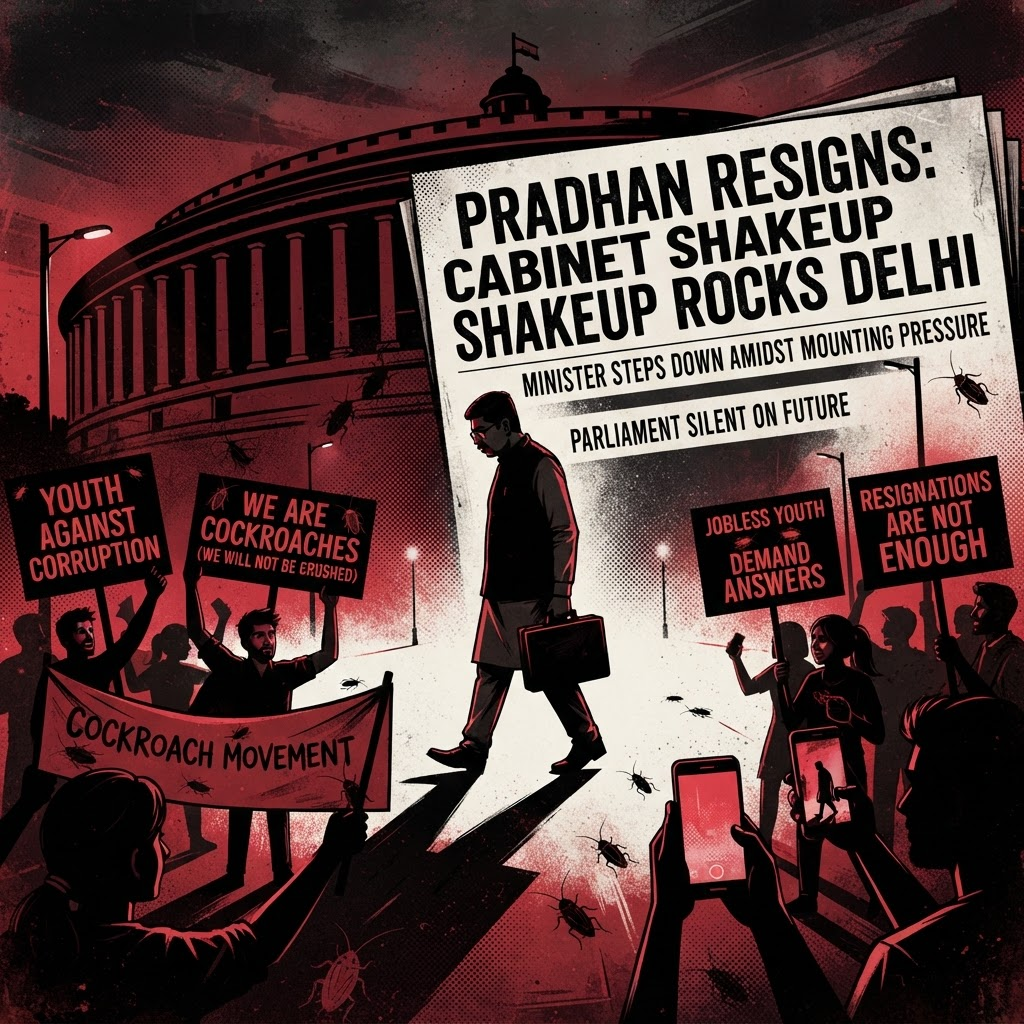
The resignation of Union Education Minister Dharmendra Pradhan on July 25, 2026, marks a watershed moment in Indian politics. In the 12-year tenure of Prime Minister Narendra Modi, this is the first time a Cabinet Minister has been forced to step down under sustained public pressure—a development many political analysts thought would never occur under this administration.
His exit was not merely a consequence of an exam leak; it was the culmination of a complex political drama involving an unprecedented Gen Z protest movement, the strategic calculations of BJP leadership, and a significant erosion of the ruling party's political capital with India's youth demographic.
The Genesis of a Movement: From CJI Remarks to the "Cockroach" Uprising
The events leading to Pradhan's resignation began long before the NEET-UG paper leak became the focal point of national outrage. In mid-May 2026, Chief Justice of India Surya Kant made controversial remarks during an open court hearing, likening unemployed Indian youth to "parasites" and "cockroaches." This comment struck a raw nerve among millions of young Indians grappling with high unemployment and a highly competitive educational environment.
On May 16, 2026, Abhijeet Dipke, a 30-year-old political communications strategist and Dalit activist, posted a simple yet provocative question on X (formerly Twitter): "What if all cockroaches come together?" This single post birthed the Cockroach Janta Party (CJP), a satirical yet powerful political movement. Dipke flew back to India from Boston to lead the protests at Jantar Mantar in New Delhi, and the movement quickly evolved from an online joke into a formidable force, amassing over 26 million followers on Instagram.
The NEET-UG 2026 Paper Leak: The Catalyst for Collapse
The actual catalyst for the political crisis was the 2026 NEET-UG controversy. On May 3, 2026, the National Eligibility cum Entrance Test was conducted for over 2.27 million aspirants. Within days, allegations surfaced that a pre-circulated "guess paper" matched nearly 120 to 140 questions from the actual exam.
The Central Bureau of Investigation launched a massive probe, uncovering a multi-state racket involving coaching centers in Rajasthan and Maharashtra, with arrests including a Pune-based chemistry professor and a school headmistress who allegedly leaked physics questions to students for payments between ₹2 lakh and ₹10 lakh. The exam was canceled on May 12, 2026, forcing over two million students to retake the test on June 21. Tragically, at least a dozen students committed suicide following the announcement, unable to bear the psychological toll of another attempt.
Why Did the BJP Delay Pradhan's Resignation?
For nearly five weeks, the Modi government maintained a defiant stance, dismissing Pradhan's resignation as a core demand of the protesters. The delay was driven by deep internal BJP dynamics and strategic calculations.
Pradhan is a cornerstone of the BJP's expansion strategy and the architect of the party's historic victory in Odisha in 2024, where the party dislodged the BJD and secured 21 Lok Sabha seats. As the most senior Union minister from Odisha, he acts as a crucial bridge between central leadership and the state unit. His removal threatened to destabilize the party's carefully managed transition of power and its outreach in eastern India.
The BJP had long projected an image of strong, uncompromising leadership. For 12 years, the party had successfully insulated its ministers from public accountability. Accepting a resignation under street pressure would have shattered the aura of invincibility surrounding the Modi government.
The government attempted alternative measures to quell the unrest without sacrificing Pradhan, including dismissing 47 National Testing Agency officials, approving a stringent anti-paper leak law with fast-track courts, and transferring the Education Secretary.
Additionally, the government was heavily focused on the Monsoon Session of Parliament, where it sought to secure a two-thirds majority for a Constitutional Amendment Bill. Conceding to the protesters too early would have disrupted their legislative agenda and emboldened the Opposition.
The Ultimatum and the Inevitable Exit
The government's strategy of stonewalling collapsed when the protests proved organic, massive, and impervious to traditional political co-optation. The movement cut across caste, class, and religion, making it impossible for the state to use its usual playbook of dividing the opposition.
When thousands of unarmed young people attempted to march to Parliament on July 20, police launched a brutal crackdown using tear gas and batons, injuring approximately 300 people and arresting 70 protesters. Social activist Sonam Wangchuk, who had joined the movement in solidarity, was forcibly removed from the protest site. These actions fueled unprecedented public outrage, with the protests swelling to include hundreds of thousands of people in Delhi and parallel demonstrations in Mumbai, Kolkata, and Bengaluru.
The final blow came during negotiations on July 25. CJP leaders refused to dilute their demands and issued a 72-hour ultimatum: resign Dharmendra Pradhan, or face another massive march to Parliament.
Realizing that the erosion of political capital had reached a critical point, the BJP leadership folded. On Saturday afternoon, July 25, Pradhan submitted his resignation letter to Prime Minister Modi, stating: "Considering the situation that has arisen at Jantar Mantar and across the country, so that anti-national forces do not take advantage of this situation… I have sent my resignation letter to the prime minister."
Conclusion: The Aftermath of a Gen Z Victory
Dharmendra Pradhan's resignation marks the first time a Gen Z-led, leaderless movement has successfully forced the ouster of a key Cabinet Minister. For the BJP, the exit is a strategic headache that opens up vulnerabilities in Odisha and provides the Opposition with a potent narrative of government weakness.
For India's youth, however, it is a definitive victory, proving that organized, peaceful dissent can still hold power accountable. As for Pradhan, history suggests this may not be the end of his political career. However, the damage to the government's relationship with the youth demographic is a challenge that the BJP will have to navigate carefully in the years to come.